Here's what performance anxiety actually costs you
Let's be real. You're in bed, things are moving in the right direction, and your brain suddenly enters full-on commentary mode. Does my body look okay from this angle? Am I taking too long? Should I be louder? Quieter? What if they're bored? By the time you realize you've spiraled, you're halfway out of your body and the pleasure is gone.
Performance anxiety is a lot like having a critic sitting on your shoulder during sex. It's not about the physical mechanics. It's about the constant evaluation happening in your head that hijacks your nervous system and keeps you locked in fight-or-flight mode instead of the relaxation you need to actually feel good.
The irony? The more you try to fix it by "performing better," the worse it gets.
Why your brain hijacks pleasure
When you're anxious about judgment, your body goes into a protective state. Your nervous system reads the perceived threat (what if they think I'm weird, too slow, too loud) and shifts resources away from pleasure zones and toward vigilance. Blood flow decreases. Sensation dulls. Your body literally becomes harder to arouse, which then confirms your worst fear that something's wrong with you. It's a loop.
This isn't a character flaw. It's neurobiology. Shame and pleasure cannot coexist in the same nervous system at the same time. One shuts down the other.
How lemon vibrators interrupt the anxiety cycle
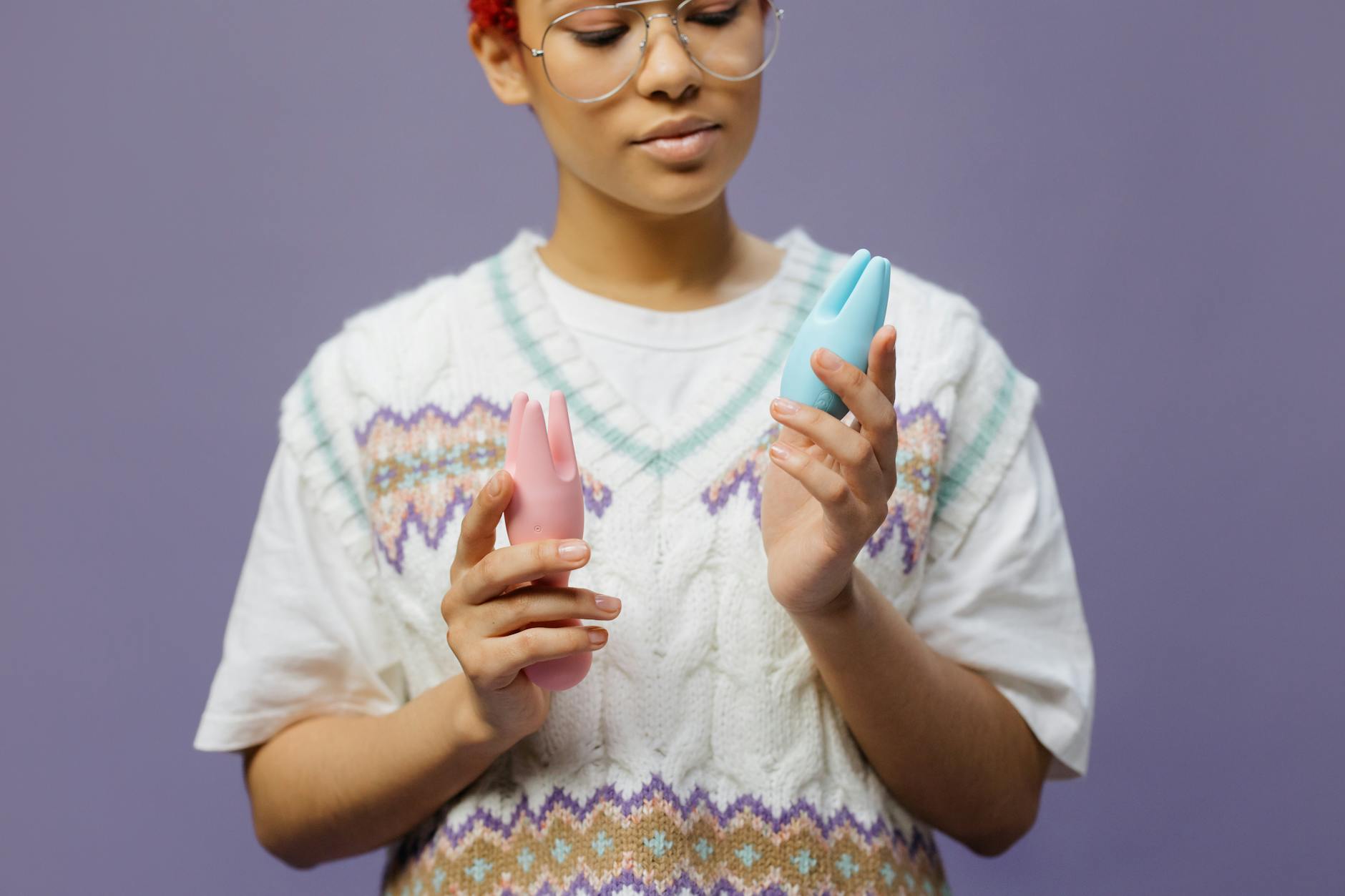
Here's where lemon sexual toys change the game. When you introduce a lemon clitoral vibrator, you're doing something specific: you're redirecting your brain's focus from "What are they thinking?" to "What am I feeling right now?"
The suction and stimulation pattern of a lemon vibrator demands presence. You can't think about judgment and feel concentrated pleasure at the same time. Your nervous system has to choose. And when you're receiving consistent, predictable stimulation, your body naturally relaxes because it recognizes safety.
This isn't magic. It's a shift from external performance metrics to internal sensation. From audience anxiety to body awareness.
Solo practice first, partnered later
The best way to rewire anxiety around judgment is to start alone. I know that sounds counterintuitive when the fear is about your partner's perception, but here's the logic: you need to prove to your nervous system that pleasure without judgment is possible. Once you've felt it, your body knows it exists.
Spend time with a lemon vibrator when you're solo, no pressure, no timeline. Notice what makes you tense up. Is it about performance or sensation? Most people discover they're holding their breath or clenching their pelvic floor without realizing it. A lemon clitoral vibrator helps you notice that, because the sensations will feel blocked or uncomfortable if you're rigid.
When you can relax into pleasure alone, you've created a template your nervous system can reference when your partner is present.
Using a lemon vibrator with a partner
When you're ready to bring a lemon adult toy into partnered sex, frame it clearly before the moment arrives. Not as "I need this because something's wrong" but as "I want to explore this together because I like how it feels." There's a massive difference.
Some people worry that introducing a vibrator signals that their partner isn't enough. In reality, a lemon vibrator gives your partner permission to stop performing too. If you're using a vibrator, the pressure to deliver an orgasm with penetration alone vanishes. Everyone can relax.
During sex, here's the practical part: start the vibrator before your partner enters, or have them use it on you while you're connected. The stimulation gives your nervous system something solid to anchor on. When anxiety tries to creep in, the sensation pulls your attention back to your body. It's grounding. It's like having something to hold onto when your mind starts to wander into the judgment zone.
What to do when anxiety still shows up
Anxiety doesn't disappear after one session. It's a pattern, and patterns take time to rewire. When you feel it surfacing during sex, here's what works.
First, pause. Not to problem-solve, but to check in. Where in your body do you feel the anxiety? Your chest? Your throat? Your pelvic floor? Name it. "I'm feeling tight in my shoulders right now." Saying it aloud to your partner does two things: it breaks the shame cycle and it brings your partner into the moment with you instead of leaving them guessing.
Second, use the vibrator as a reset button. A few minutes of direct, focused stimulation tells your nervous system you're safe. Your body remembers what it feels like to be in pleasure mode.
Third, don't try to force the orgasm. This is critical. The moment you start performing again, the anxiety returns. Instead, focus on what feels good without a destination. That shift from outcome to sensation is where the real healing happens.
The role of communication
Here's something I see repeatedly in my practice: the partners of anxious people are usually relieved to understand what's happening. They're not mind readers, and without communication, they often think you're pulling away from them or that they've done something wrong.
Telling your partner, "I have anxiety about being watched, and I'm working on it. This vibrator helps me feel more in my body," transforms the dynamic. Your partner becomes an ally instead of the perceived threat. Many couples find that this conversation itself reduces anxiety because it replaces mystery with clarity.
When to seek additional support
If performance anxiety is tied to trauma, depression, a history of shame, or if it's blocking you from sex almost entirely, a therapist trained in both sex and attachment is worth the investment. Lemon vibrators are a powerful tool, but they're not a substitute for processing deeper wounds. Think of them as part of the toolkit, not the whole toolkit.
The truth underneath the anxiety
Your body is not the problem. Your performance is not the problem. The problem is the belief that your worth is determined by someone else's evaluation of your pleasure. That belief is learnable, and it's also unlearnable.
When you use a lemon clitoral vibrator and feel genuine pleasure without an audience in your head, you're reclaiming something. You're proving to yourself that your body is safe, that pleasure is available to you, and that you deserve to experience it without running commentary. That's not indulgence. That's recalibration.
People also ask
Can a lemon vibrator actually reduce anxiety during sex?
Yes, but not because of magic. A lemon sexual toy works because it anchors your attention in your body and away from the anxiety spiral in your head. When you're receiving specific, predictable stimulation, your nervous system has to choose between processing that sensation and processing fear. Sensation usually wins. Over time, this rewires your nervous system to associate partnered sex with safety instead of judgment.
How do I introduce this to my partner without making it awkward?
Timing matters. Don't bring it up mid-intimacy or when you're already anxious. Have the conversation when you're both clothed, calm, and not about to have sex. Say something like: "I've noticed I get in my head during sex, and I want to work on being more present. I'd like to try using a vibrator, and I want to explore this with you." Then ask what they're thinking. Most partners feel relieved to have a tool that helps instead of trying to guess what's wrong.
Is using a lemon vibrator a sign I can't relax on my own?
No. It's a sign you're being smart about how your nervous system works. Just like you use a pillow to support your head at night, a vibrator supports your nervous system during sex when anxiety is active. The goal isn't to eventually not need one. The goal is to use whatever helps you feel safe and present.
What if my partner feels replaced by the vibrator?
This usually comes from the belief that your pleasure should come only from your partner, which is a setup for resentment on both sides. A lemon clitoral vibrator is not a replacement. It's a tool that lets your partner off the hook for performing and lets you off the hook for managing their ego while you're trying to have pleasure. Most couples find that sex actually gets better and more connected when a vibrator is part of it.
How long does it take for performance anxiety to improve?
It depends on how long you've had it and how deep it goes. Some people notice a shift in a few weeks of regular practice. Others take months to fully rewire the pattern. The important thing is consistency. Using a lemon vibrator once won't fix years of anxiety. But consistent, judgment-free sexual exploration will change your relationship to pleasure permanently.
Can I use a lemon vibrator if I'm on antidepressants or other medications?
Yes. Most medications don't interact with vibrators. What can happen is that some medications numb sensation or make orgasm harder to reach, which can amplify performance anxiety. If that's your situation, explore how lemon vibrators help restore sensation when medication affects arousal. That's a different conversation than anxiety, but the tool is the same.
Sources and references
Finkel, E. J., & Campbell, M. C. (2001). Self-control and accommodation in close relationships: Do the same regulatory processes underlie commitment and accommodation? Journal of Personality and Social Psychology, 88(5), 822-837.
Janssen, P. L., Meulebroek, W., & Braat, D. D. (2013). Antidepressant-induced sexual dysfunction: A meta-analysis of randomized, placebo-controlled trials. Psychoneuroendocrinology, 39(1), 102-117.
Palsson, S., Öström, H., Staël von Holstein, T., & Thobaben, M. (2008). Performance anxiety in patients with sexual dysfunction. The Journal of Sexual Medicine, 5(11), 2567-2575.
Van der Kolk, B. A. (2014). The body keeps the score: Brain, mind, and body in the healing of trauma. Viking Publishing.
Gottman, J. M., Coan, J., Carrère, S., & Swanson, C. (1998). Predicting marital happiness and stability from newlywed interactions. Journal of Marriage and Family, 60(1), 5-22.